USD/CAD at the 200-Day: What the Tariff Deadline Means for the Next 100 Pips
USD/CAD has fallen nearly four cents since late June and now sits at its 200-day moving average with 50 percent tariffs on Canadian goods scheduled to take effect in less than 24 hours. The technical setup and the political catalyst are colliding at the same price level. This analysis breaks down the data, the negotiation dynamics, and two clear scenarios for where the pair goes next.
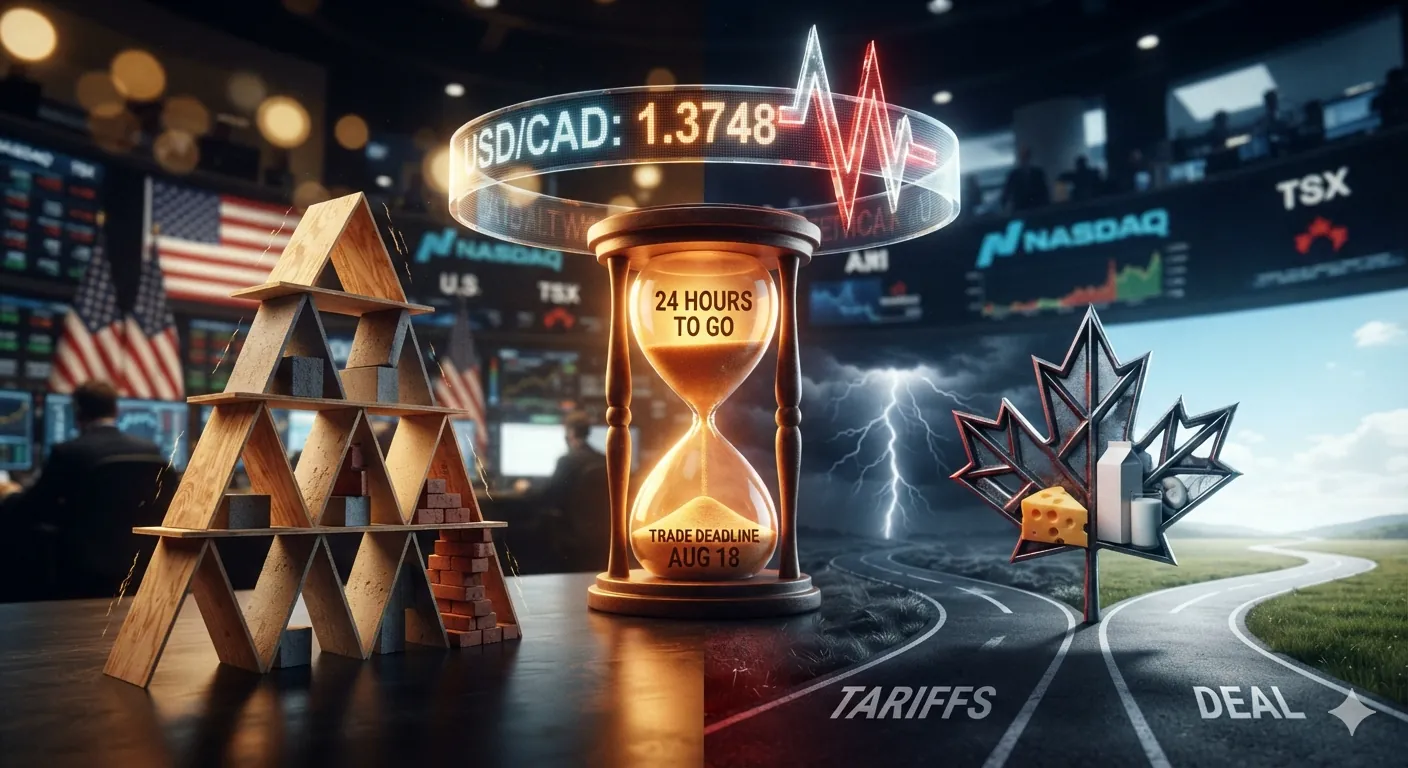
The Deadline and What It Covers
On July 20, the Trump administration announced 50 percent tariffs on roughly US$20 billion of Canadian goods under Section 338 of the Tariff Act of 1930, a Depression-era provision that has never been used. The tariffs were delayed for 30 days to allow negotiations. That window closes at 12:01 a.m. Washington time on Wednesday, August 19.
The targeted products include hockey sticks, cement, plywood, dairy (milk, whey, cheese), clothing, liquor, fishing rods, and particle board. Energy, potash, fish, and critical minerals are excluded. According to U.S. Census Bureau data, the tariffs would cover approximately 5.2 percent of the $383 billion in goods the United States imported from Canada in 2025.
| Category | Examples | Status |
|---|---|---|
| Building materials | Cement, plywood, particle board | Targeted |
| Dairy | Milk, whey, cheese | Targeted |
| Consumer goods | Clothing, liquor, hockey sticks, fishing rods | Targeted |
| Energy | Oil, natural gas | Excluded |
| Industrial inputs | Potash, critical minerals | Excluded |
| Seafood | Fish and marine products | Excluded |
Source: U.S. Census Bureau trade data, 2025 import figures.
The White House framed the move as retaliation for Canada's counter-tariffs on U.S. goods, which Ottawa imposed after earlier levies on steel, aluminum, and autos. USTR Greer stated at the Iowa State Fair that the U.S. would not tolerate retaliation. The U.S. Chamber of Commerce responded on Monday by warning the tariffs would damage both economies and risk the 13 million American jobs dependent on USMCA trade.
Where Negotiations Stand
Prime Minister Mark Carney described talks as "very intense and delicate" on Monday. He spoke by phone with Trump that afternoon. Canada-U.S. Trade Minister Dominic LeBlanc met with USTR Greer and Commerce Secretary Lutnick in Washington and told reporters afterward that "our job is not yet done." No details were released from either conversation.
Three Sticking Points
| Issue | U.S. Position | Canada Position | Gap |
|---|---|---|---|
| Auto tariffs | Cut to 15% from 25%, U.S.-made content exempted | Tariff-free for all North American content under USMCA rules | Wide |
| Dairy access | Open Canadian market to U.S. dairy exports | Maintain supply management system with quotas | Structural |
| USMCA rules | Tighten rules of origin for vehicles | Preserve existing USMCA framework | Moderate |
Sources: Bloomberg, Reuters reporting on negotiation positions as of August 18, 2026.
The auto sector is the hardest obstacle. Stellantis informed Unifor on August 12 that it is in discussions to sell its Brampton Assembly Plant, idle since December 2023 with more than 2,200 workers on layoff. Unifor also opened contract talks with General Motors this week, with the Detroit Free Press reporting GM is pushing back harder than Ford did in June.
An Angus Reid Institute poll found 59 percent of Canadians want Ottawa to hold firm even if tariffs take effect. Only 26 percent favored concessions. The political dynamics on both sides are narrowing the space for a last-minute deal.
Inflation Data: Hot Headline, Tame Core
Canada's July CPI report landed on Monday with a split signal. Headline inflation rose to 3.0 percent year-over-year, up from 2.8 percent in June and one-tenth above consensus. The acceleration was driven by gasoline prices, which surged 25.7 percent year-over-year as the U.S.-Iran ceasefire unraveled and global oil prices climbed. Airfares rose 12.0 percent.
| Measure | July | June | Consensus |
|---|---|---|---|
| Headline CPI (YoY) | 3.0% | 2.8% | 2.9% |
| CPI-trim | 1.9% | 1.9% | 1.9% |
| CPI-median | 2.0% | 1.9% | 1.85% |
| Gasoline (YoY) | 25.7% | 20.5% | n/a |
| Air transport (YoY) | 12.0% | 9.6% | n/a |
| Food from stores (YoY) | 3.1% | 3.9% | n/a |
| Shelter (YoY) | 1.3% | n/a | n/a |
Source: Statistics Canada, CPI release August 18, 2026.
The Bank of Canada's preferred core measures remained well-behaved. CPI-trim held at 1.9 percent and CPI-median ticked up to 2.0 percent, both close to the Bank's 2 percent target. BMO senior economist Robert Kavcic described the picture as "stable and well-behaved despite a bit of heat in July."
The relative data flow between Canada and the United States has shifted meaningfully. Citi's Economic Surprise Index for Canada moved from deeply negative to sharply positive since mid-year, while the U.S. equivalent collapsed. The spread between the two is at its widest since early 2026. Markets now price a full Bank of Canada rate hike by year-end, while Fed tightening expectations have fallen from 43 basis points to just 21 basis points by December.
The inflation side is looking stable and well-behaved despite a bit of heat in July.
Robert Kavcic, Senior Economist, BMO Economics
Technical Setup: The Levels That Matter
USD/CAD has been in a clear downtrend since topping in late June, setting a sequence of lower highs and lower lows. On Monday, the pair retested its 200-day moving average, a level that has served as both support and resistance throughout 2026.
The initial break beneath the 200-day average failed to hold. The pair reversed back above both the moving average and the 1.3870 horizontal level, printing a bullish pin candle. After a four-cent bearish move, this type of reversal pattern at a widely watched indicator carries technical significance.
| Level | Type | Significance | Signal |
|---|---|---|---|
| 1.3870 | Horizontal | Support/resistance tested multiple times in 2026 | Held Monday |
| 200-day SMA | Moving average | Long-term trend gauge | Held Monday |
| 1.3919 | 100-day SMA | First overhead resistance | Untested |
| 1.3967 | Horizontal | Secondary resistance | Untested |
| 1.3991 | Horizontal | Upper reversal target | Untested |
| 1.3775 | Horizontal | Minor support below 200-day | Downside target |
| 78.6% Fib | Retracement | Of Sept 2024 to Feb 2025 bull move | Deep support |
The oscillators tell a different story from the price action. RSI (14) sits at 29, marginally in oversold territory and still printing lower highs and lower lows, indicating downside momentum remains intact. MACD continues to trade below its signal line in negative territory. This divergence between a bullish price signal and bearish momentum indicators is what makes the tariff deadline so consequential for positioning. For traders who want to see how setups like these get turned into repeatable rules, my breakdown of how systematic trading turns raw market data into tradeable decisions covers the process end to end, while my guide to predicting forex market trends walks through the forecasting models behind momentum calls like these.
Two Scenarios for the Next 24 Hours
Scenario A Tariffs Take Effect
If the 50 percent duties go ahead at 12:01 a.m. Wednesday, USD/CAD would likely spike higher initially on safe-haven dollar flows. The 2018 steel and aluminum tariff episode produced a roughly 3 percent USD/CAD rally in two weeks before reversing as markets digested longer-term growth implications. Capital Economics warned the tariffs threaten Canadian growth and could reignite a tit-for-tat trade war. If the Bank of Canada begins signaling rate cuts to offset the trade drag, the loonie weakens further out the curve.
- Short-term: USD/CAD higher (dollar safe-haven bid)
- Medium-term: Uncertain, depends on BoC response
- Key level: A break above 1.3919 (100-day SMA) confirms reversal
Scenario B Deal or Delay
Wolfe Research analyst Tobin Marcus argued the most likely outcome is that the tariffs will be delayed or canceled before the deadline. Prediction market Kalshi assigned a 45 percent chance of tariffs actually taking effect as of Monday. If a deal materializes, even a partial one focused on auto tariff reductions, the Canadian dollar could rally sharply. The bearish trend in USD/CAD would extend, with 1.3775 as the next target.
- Short-term: USD/CAD lower (CAD relief rally)
- Medium-term: Bearish trend extends toward 1.3775
- Key level: A break below the 200-day SMA opens 1.3775 and the 78.6% Fibonacci
Scenario C Noise Without Resolution
A vague announcement that talks are continuing, without a concrete deal or deadline extension, would leave traders in limbo. USD/CAD would likely remain range-bound between 1.3870 and 1.3919 until clarity emerges. This is the scenario that frustrates positioning the most, because it resolves nothing and forces traders to carry exposure into the next news cycle.
- Short-term: Range-bound between 1.3870 and 1.3919
- Medium-term: Depends on subsequent headlines
- Key level: 1.3870 to 1.3919 becomes the range to trade
What Else Moves USD/CAD This Week
The tariff deadline is not the only catalyst. The FOMC's July meeting minutes are released on Wednesday, and they will reveal whether the three regional Fed presidents who dissented in favor of a hike represented a broader hawkish tilt within the committee. For a closer look at what a higher-rate environment means for the dollar and global markets, my analysis of higher U.S. rates and a stronger dollar breaks down the winners, losers, and ripple effects. Canadian producer price data arrives on Thursday and retail sales on Friday, providing two more data points for rate expectations.
Georgetown trade law professor Jennifer Hillman told Energi Media that Section 338 tariffs face serious legal challenges, since the provision was designed for countries that discriminate against U.S. commerce, not countries with which the U.S. has a free trade agreement. If the tariffs are imposed and then challenged in court, the uncertainty could persist for months.
Globally, allies are hedging against unpredictability. Denmark chose Franco-Italian air defense over the U.S. Patriot system. Canada is re-evaluating its F-35 commitment. Mexico is consolidating its USMCA advantage as Canada's position weakens. The Macdonald-Laurier Institute's Jamie Tronnes wrote that the tariffs "poison the well for global investment." When governments do step into currency markets to defend a position, the stakes can run into the trillions, as shown by my deep dive into the historic US-Japan yen intervention of 2026.
The Setup in Summary
USD/CAD is coiled at a technically significant level with a binary political event hours away. The price action suggests reversal. The momentum indicators suggest continuation. The tariff deadline will determine which signal wins. For traders, the next 24 hours come down to whether 1.3870 and the 200-day SMA hold or break. My companion piece, The 24-Hour Trade: Why USD/CAD Is Coiled for a Breakout Before Wednesday's Tariff Deadline, puts the same setup in longer-form context for LinkedIn readers.